

Vegan Laksour
Ingredients
For the pancakes:
1.5 cups (180g) flour
1.5 cups (180ml) water
Salt
For the laksour:
2 cans shredded jackfruit
1 onion, diced
2 bell peppers, chopped
2 potatoes, peeled and chopped
2 carrots, chopped
2 tbsp tomato paste
1 tbsp soy sauce
1 bay leaf
3 cups (700ml) vegetable broth
Salt
Pepper
Instructions
- Combine water and flour in a bowl with a pinch of salt. Mix to create a smooth batter, then set aside.
- Heat oil over medium heat in a small pot. Add the onion and cook until soft (~3-4 minutes). Add the remaining vegetables, and stir.
- Add the vegetable broth, tomato paste, bay leaf, and soy sauce. Stir to combine. Bring to a boil, then lower to a simmer.
- Heat oil in a flat pan. Add one ladleful of pancake batter to the pan, using the underside of the ladle to make the batter as thin as possible. Cook until bubbles appear on the surface and the edges begin to rise from the pan, then flip. Repeat until all the batter has turned into pancakes.
- Place the pancakes on a plate, then scoop the laksour on top.
A longer and more detailed description
For a place as seemingly barren as the Sahara, it keeps having absolutely banger dishes. Admittedly, I think this one struggles a bit more for its lack of meat, but it is nevertheless proof that African dishes are absolutely stellar. Africa does not miss.
This particular dish is a bit labour intensive, but well worth it. Start by mixing equal parts flour and water in a bowl with a pinch of salt, then setting it aside. It needs to think about what it would like to become, which is best done when it has time to think. While the batter is having its happy little think, get all the veggies going into their stew. Heat oil in a pot, then chunk in the onion. Once it feels right, add in the remaining veggies, then give them all a mixy mix. Add the liquids and spices, stir it all together and bring it to a boil, then lower it to a simmer. Let everything soften and cook while you make the accompaniment.
While the stew is cooking, make the pancakes. Heat oil in a pan over medium heat, then add a ladleful of batter to the pan. Spread it around as best you can, then wait impatiently for the top to start showing little bubbles. Once it does, flip it and wait until that’s done as well. Repeat until you run out of patience, batter, or both. Serve the stew over the pancakes, ideally using the pancakes to scoop and eat the stew with your hands. !بالصحة
Substitutions and suggestions
For the flour - This should ideally be made with a combination of millet and wheat flour. I, however, only have wheat flour, so used that. Feel free to use whatever flour you would like.
For additional spice - I found the end result to lack a bit more oomph than I would like, so I added some chili oil, which was delightful. If you do not like chili oil, do not add chili oil.
What I changed to make it vegan
This is ordinarily made with lamb or camel. I am not going to use either lamb or camel, so I used jackfruit instead, then added soy sauce for the extra bit of meaty flavour.
What to listen to while you make this
Mauritanian music benefitted in world attention from the rise of Tinariwen and desert music more broadly. In that vein, then, I’m going to recommend the album “Moorish Music from Mauritania” by Khalifa Ould Eide and Dimi Mint Abba, and specifically the song “Oh Lord Bring Apartheid Crashing Down.”
It worked. There is no more Apartheid, at least not in South Africa.
A bit more context for this dish
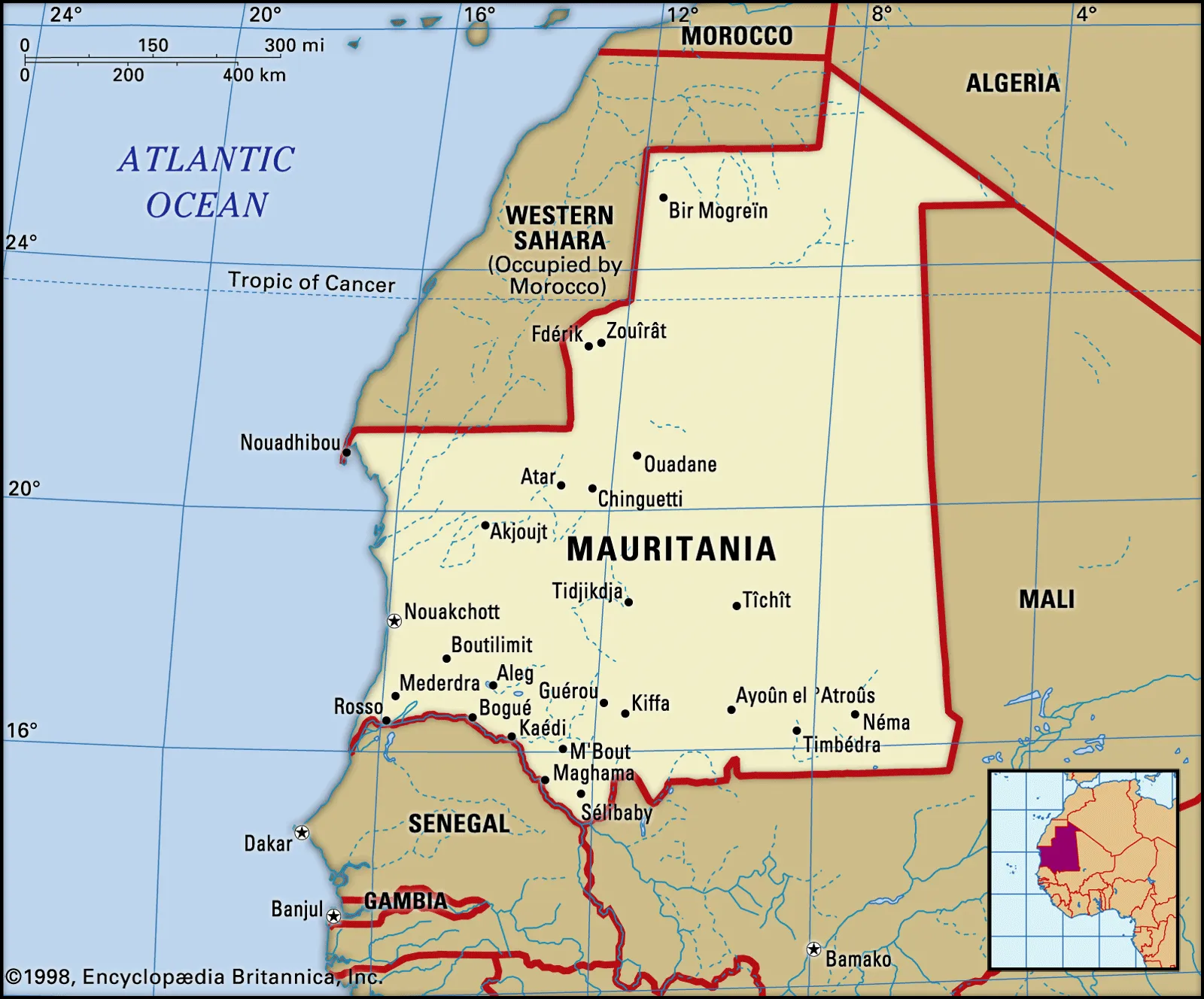
Mauritanian cuisine is defined by the desert. While it has influence from both Moroccan and Senegalese traditions, it is defined by its geography. It features couscous and rice served with sauces, and a heavy use of meat such as lamb and camel. On the coast, fish becomes a more popular ingredient, but inland, the people live on what they can harvest from the Sahara. Dishes are traditionally eaten with the hands, using the couscous or bread as a scoop.
I fully admit that, prior to making this dish, I did not know very much about Mauritania. Despite its size, it’s sparsely populated (its population is about half that of the Dallas-Fort Worth metropolitan area), with its population being desperately impoverished. Like many former French colonies, its modern history has been defined in opposition to its colonial rule, with French influence being seen as anathema, and Mauritania’s existence being seen as part of a general anti-colonial struggle. Beyond that, though, there is one thing and one thing only that springs to mind when I think of Mauritania.
Mauritania is notorious for its large population of enslaved people and the ubiquity of slavery within society.
 An enslaved family in Mauritania (Source: The Guardian)
It is unclear how many people in Mauritania are enslaved. Local groups estimate it’s as much as 20% of the population, while organisations such as Walk Free estimate it to be closer to 3.2%. Even within these estimates, though, it is worth considering the sheer scale of slavery in Mauritania. The low end of estimates places the number of enslaved people at ~150,000, an astounding number of people.
Part of why Mauritania holds the reputation as the last bastion of slavery is because of how late it formally abolished the practice. While French colonisers abolished slavery in 1905, they did nothing to actually stamp out the practice. Similarly, while the Mauritanian government outlawed slavery in 1981, they’ve done nothing to actually enforce that ban, leading to the practice’s continuation.
A larger part of why it continues lies in Mauritania’s colonial history, its societal structure, and how it views slavery as a part of its fundamental identity.
 An enslaved family in Mauritania (Source: Council on Foreign Relations)
Slavery in Mauritania predates colonialism, with slavery existing in some form for an unknown amount of time. Under the caliphates of the 14th and 15th centuries, slavery became a more economic institution, with significant investment in shipping slaves throughout Mauritania.
Where Mauritanian - and Saharan slavery more generally - slavery differs from the more European conception of slavery is in its purpose. While there was (and remains) an economic motivation, the economic motivation is not necessarily the driving factor. Instead, slavery is seen as an expression of the innate caste system. The white Beidane are seen as superior to the black Haratin, with that superiority being ordained within Islam itself. It is a religious fact that the Arabs are dominant over the black Africans, an idea shared across the Sahara. To question this caste system is to question Islam itself, as the relationship between the two groups is a religiously perpetuated one.
So not that terribly different from European slavery after all, then.
 An enslaved family in Mauritania (Source: CNN)
When the French colonised Mauritania, they did so as part of a larger project to colonise Senegal. In 1905, the French outlawed slavery, but did nothing to reinforce the ban. Instead, in the eyes of the slaveowners, the French attempts to ban slavery were part of the general system of colonisation and an attempt to wipe out the traditional way of life. Equally, the French, through their own racial politics, had no incentive to upend the existing caste system. In the eyes of the French, there was a correctness in it, with black Haratin obviously being inferior to the white Beidane.
When Mauritania gained its independence in 1960, slavery was still very much a part of society, as was the caste system as a whole. However, Mauritania gained its independence within the general wave of west African independence, with a sense of pan-Africanism pervading the newly independent state’s politics. It wasn’t enough to be African. Rather, being African meant rejecting all European influences and forging a new path. Paired with this was a sense of pan-Arabism, reinforcing Arab identities to the further rejection of European ideas and languages. The idea of ending slavery had been a European one - to reject it was to reinforce the inherent Arab and African identity of the newly formed state.
Slavery became part of what it meant to be Mauritanian. It was a rebellion against European colonialism, and worth preserving for that reason.
Slavery continues in Mauritania both because of tradition, and because of the sense that it is a necessary part of Mauritanian identity. It isn’t something to be shirked from, but rather part of the natural order of things. It is how the world works, and to suggest otherwise would be to replace Mauritanian identity with a foreign ideal.
 Formerly enslaved women learning new skills in Noukachott (Source: CNN)
Mauritania is often called the last bastion of slavery, and it’s easy to see why. Slavery in Mauritania is matrilineal - the children born to an enslaved woman are themselves enslaved, and most of the enslaved people in Mauritania were born into it. When something is so engrained in every facet of life, it can be difficult to imagine how to escape or what might lie beyond. When paired with how remote so many people in Mauritania are, it becomes easy to see how the system might persist.
To my knowledge, Mauritania is the only country in which people are born into slavery. While human trafficking is epidemic, and prison labour serves as an entire system of slavery, with the possible exception of North Korean prison camps, Mauritania might be the final bastion of birthright slavery.
However, to say it is the last bastion of slavery strikes me as an interesting statement. Given that the Gulf petrostates are reliant on enslaved labour for basic functionality and on a far more massive scale than Mauritania, it seems odd to single out Mauritania for the moniker of the last bastion. What might instead be worth considering is that Mauritania is the last bastion of a particular model of slavery, one that had been found throughout the Americas until the 19th century, that idea of a slave as a possession, of a person without personhood, free to be traded and sold, born into it with no hope of liberation.
To say Mauritania is the last bastion of slavery as a whole, though, is to neglect how endemic slavery is to the modern world economy. Enslaved labour mines the minerals that fuel our electronics, harvests the seeds for our chocolate, manufactures the clothing we wear. The difference is that that slavery is for the benefit of westerners, committed incidentally by westerners, and serves a function in the global economy. Mauritanian slavery, by virtue of Mauritania’s poverty and distance, does not.
Mauritania is the last bastion of slavery we do not need to hold on our own consciousnesses. Liberating the Haratin, however, is not the end of slavery.