

The Outer Worlds 2
I will be honest - I was not a terribly big fan of the original Outer Worlds. A friend pitched it to me as his favourite game, saying I would love it because it was “New Vegas in space.”
I love Fallout: New Vegas. I love space. I did not love Outer Worlds.
What I found when I played the original Outer Worlds was a world that tried very hard to seem vibrant and dynamic, while also failing completely at convincing me that it didn’t all fade away as soon as I turned my back. I do not remember the companions’ names. I do not remember much of the plot. All I remember about it was the sense of hollowness that pervaded everything I did within it.
Upon hearing I had played and could nominally recognise elements of the first Outer Worlds, a different friend’s face lit up, and he sent me a copy of the Outer Worlds 2 for my birthday. I did not have the heart to tell him that I didn’t much care for the first one, nor could I leave this game sitting unplayed in my library. Instead, as my friend reiterated that it was one of his favourite games and sang songs from the soundtrack to me and quoted memes he’d made about the game, I realised I had no choice but to go back to a series I hadn’t previously had any intention of revisiting for reasons that were not wholly my own.
But here I am, sixty hours later, nonetheless sharing my thoughts on the Outer Worlds 2.
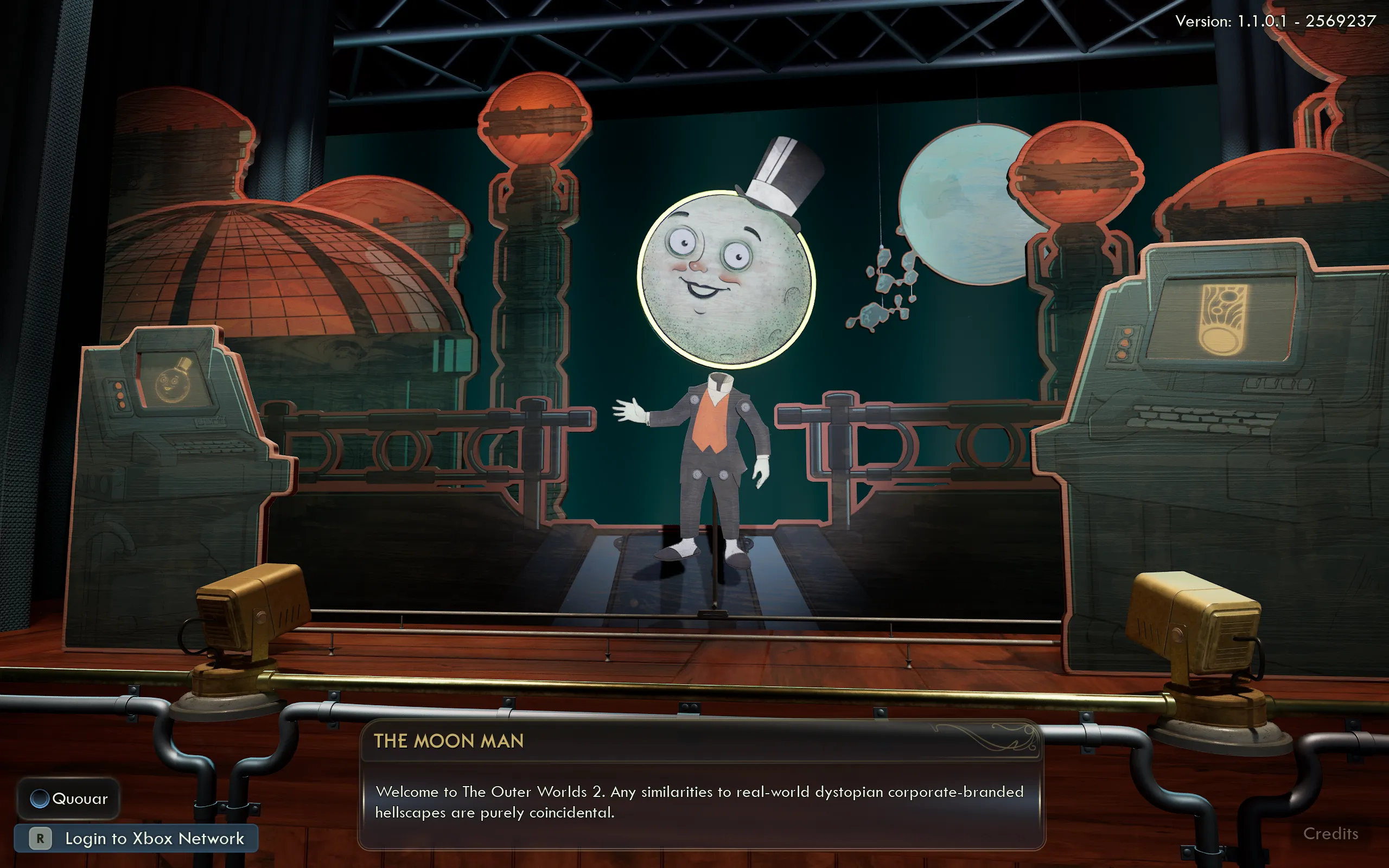
Outer Worlds 2 is a sci-fi RPG. Set in the far off solar system of Arcadia, Outer Worlds 2 follows the adventures of a pseudo-interstellar sheriff. Initially tasked with investigating potentially system-destroying space anomalies called rifts, the player instead finds themselves in a rapidly deteriorating and chaotic situation, culminating with them being cryogenically frozen and launched into the depths of space. Upon being reawakened, it’s up to the Commander and her intrepid crew to bring peace to Arcadia and solve the mystery of the rifts.
One way the original Outer Worlds was pitched to me was as a spiritual sequel to Fallout: New Vegas. It’s a moniker that is more aptly applied to Outer Worlds 2 than its predecessor, even if it’s more clearly an inspiration than a direct ancestor. Outer Worlds 2, in addition to its underlying mysterious plot, the Commander must navigate their relationship with a variety of factions, using these relationships to improve their ability to investigate the rifts. Allying with any particular faction, for instance, shapes not only the Commander’s destiny, but that of the entire Arcadia system. There is, after all, a war on in Arcadia, and who wins that war is paramount in what the system’s future will be. How the mystery resolves is very much a consequence of choices made along the way, with the consequences of those choices sometimes having ripple effects well beyond what was expected.
The Commander, however, is not on her own as she embarks on this mission to save Arcadia. Instead, she is accompanied by a cast of companions, each hailing from one of Arcadia’s factions. Each companion has their own storyline and personal arc, though what the outcome of each of these is is entirely up to the player.
The Outer Worlds 2’s character stems from its writing, and it’s worth considering that writing on both a macro and micro scale. On a line level, the writing is fine, with the game’s constant satire never getting old. Every time I thought I’d seen the best line of the game, it managed to surprise me, pulling out another iconic line for me to delight in. Its combination of old Western-style English with sci-fi gobbledygook is a joy to engage with, and did more to build the world and its people than any of the actual world design.
 I feel this in my bones
This is not to undersell the world design itself. While my complaints about the world feeling sparse and hollow haven’t really abated since the original Outer Worlds, that doesn’t change that there is a beauty in how these worlds are designed and the activity within them. While areas don’t particularly change or give the player a reason to revisit them, initial visits to places are excellent and do a great deal to tell the story of Arcadia without needing to blatantly say it. Walking into a company town and hearing the constant blaring of advertisements and corporate jingles does everything to tell me about the dystopian hellscape that is this world. The landscape itself directs the player’s gaze to landmarks and goals, with the map speckled with side stories and little events that provide flavour to the world as a whole.
Where the Outer Worlds 2 has a rich setting, however, it does not necessarily pair that setting with a compelling overarching story. The mystery of the rifts, for example, while it should theoretically pull the player forward, isn’t as interesting as the stories the Commander encounters in their journey through Arcadia. Despite representing an existential risk, I’m a lot less interested in the rifts than in saving a town from mass execution for having the audacity to not forestall an invasion. The nature of the rifts as an existential yet nebulous threat makes it easy to push them to the background, to focus on the small scale problems and what’s controllable rather than something more unclear.
…hang on, this game is about climate change, isn’t it…
 I thought so...
That the main plotline is a mystery does make it difficult to follow at times, especially given how far the story sometimes meanders from being able to investigate said mystery. The preponderance of factions, while helpful for the world, ultimately serve to direct attention away from the underlying story and instead towards their actions and their smaller stories. Yes, the war is pointless if the rifts devour the system, but given that the war is all the player sees and engages with, it’s difficult to argue against it being a clearer stake in the player’s mind.
None of this is, of course, helped by the fact that I have a day job and was playing this game sporadically for maybe five or six hours a week. It’s harder to keep track of the elements of a thriller when I’m having to make space for them alongside thoughts like “lesson planning” and “submitting conference papers.”
Also not helping cultivate the sense that the main plotline is important is the fact that roughly a third of it is skippable. There comes a point where the game looks at the player and tells them that, to advance, they need to curry favour with at least one of the game’s factions to continue. This involves completing a long series of fetch quests, solving mundane problems or sorting out issues over and over until one of the factions likes the player enough to help them.
Or you could do what I did and accidentally stumble into the next step of the plot, then solve it on your own. I found this much less tedious. I’m sure doing it this way has an impact on the overall plot, though what that could be, I never figured out.
 Okay, maybe the game does comment on it.
This is one of the major contradictions of the Outer Worlds 2. On the one hand, its writing is a delight, with each line somehow managing to bring me joy, even after 60 hours in the game. On the other hand, its writing is a complete mess, with storylines contradicting themselves, events not making sense unless done in a particular order, and entire swaths of the story entirely skippable. It creates the impression of a game that wants to look pretty and have a compelling setting that nevertheless says very little. I’ll not deny that it is a pretty game with pretty ideas and pretty moments, but beneath that lies the same hollowness that left me feeling very little after the first Outer Worlds. It’s not a world to get lost in, but instead a tour the player is being taken on of someone else’s ideas. There may be a story behind them, yes, but that is less important than the moment-to-moment experience of being in the game.
This difficulty with the writing is highlighted by the companions themselves. While there are numerous factions in the game, not all factions are created equal; some are a fundamental part of the story’s ultimate resolution, while others are little more than mooks. However, that a faction might be populated by nothing but cannon fodder doesn’t change that the companion from that faction is meant to be seen as a person all their own, with you being expected to take them seriously as people.
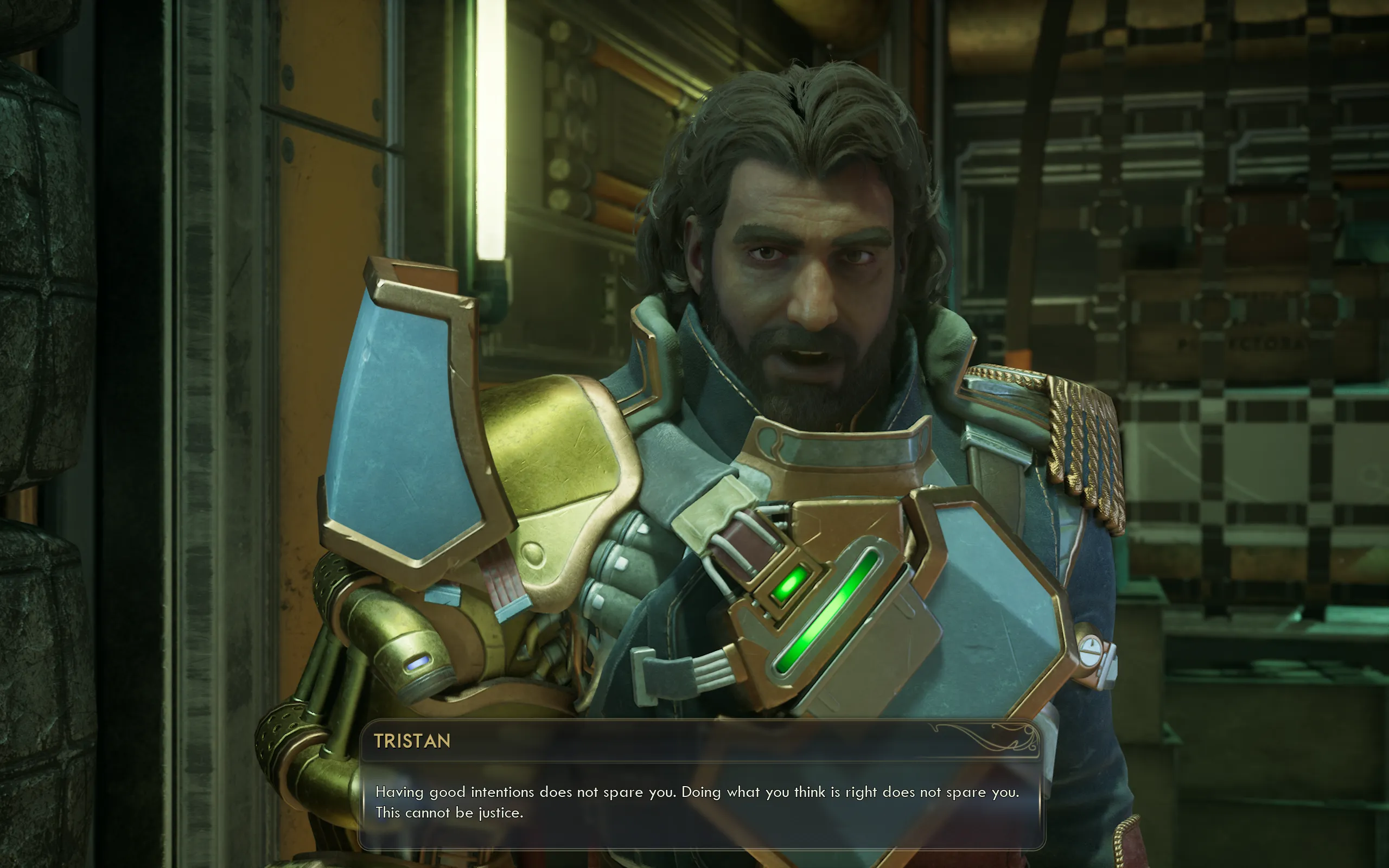
Take, for instance, Tristan. Tristan is a companion from the Protectorate, the game’s overall villain, a faction that can never be allied or peacefully interacted with. While Tristan has a fulfilling arc about learning to be his own person, he does so in the context of people he knows being gunned down in increasingly ridiculous ways. As I moved through spaces with Protectorate soldiers, I listened to them discussing their dinner plans, their hopes, their fears, doing all the things that made them human. I was then expected to charge through them, mowing them down for the crime of not happening to be Tristan, with their ostensible comrade cheering me on as I did so.
This is a problem with many RPGs and FPSs, but it’s especially true in Outer Worlds 2. The game goes to such lengths to flesh out the setting without recognising the consequences of doing so. When the person at my side is telling me how good their friends are and their memories of joy with them, killing them only makes me feel like a monster. That the game leaves me no choice but do so just raises questions of what it is I’m meant to be doing. The game is irreverent, yes, but nothing about it gives the impression that I should be considering whether I am making the world an actively more desolate place.
With all this said, I did end up enjoying Outer Worlds 2 more than I thought I would. Its satire and ridiculousness are good fun, and I enjoyed exactly the elements the game thought I should enjoy - those moments, those lines, those brief snippets of excitement in between the long stretches of empty land. While the gameplay got tedious and the quests repetitive, the small stories and the line-by-line writing kept me going, knowing something would make me laugh soon.
I don’t dislike the Outer Worlds 2. That doesn’t change that, as I played it, I noticed all the elements where it could have been something more, could have had a more coherent story, could have done a little more to make the world feel real. It’s a perfectly fine game, but with the understanding that that is all it is.
Oh, that and a soundtrack. Its soundtrack is phenomenal.
Developer: Obsidian Entertainment
Genre: RPG
Year: 2025
Country: United States
Language: English
Play Time: 60 hours